


Mail art or postal art?


The history of mail art in France remains largely to be written. This artistic practice seems less developed there than elsewhere – as evidenced by a clear preference for the Anglo-Saxon term, compared to the French "Art-Postal".
Mail art is a movement born from a desire to break down the elitist barriers of galleries and museums. The founding idea was simple: art should circulate freely among people, without money or profit. Artists sent each other collages, visual poems, and stamps. It is above all an artistic proposition where the postal service serves not only as a means of circulation but also contributes to the aesthetic or conceptual realization of the project.
The golden rule: Total freedom, summed up by the formula "no fees, no jury, freedom of technique and format." It is an art of exchange, free and independent of the art market. The materials used are extremely varied, as are the techniques: photography, drawing, collage, painting, calligraphy…
The attributes of the Post Office: address of the recipient and sender, stamp, cancellation are obviously part of the materials of postal art.
Ancestors of Mail Art can be found in:
· The Italian Futurists Art in everyday life : By exploiting the postal network, the Futurists wanted to take art out of the museums and galleries they were fleeing, to inject it directly into people's daily lives.
Speed and modern communication : The stamp, the postmark, the railway lines, and the speed of postal delivery perfectly embodied the cult of speed, technology, and modern life inherent in their manifesto

· The Dadaists 1910-1920 .
While the Futurists invented the medium, Dada introduced satire, nonsense, and political subversion. The link between Dada and Mail art is primarily conceptual and groundbreaking; the exchange of ideas is more important than the preservation of the object.

The legacy of Futurist mail art was organically passed on to other 20th-century avant-gardes, but with a radical shift in spirit. Where the Futurists used the mail as a tool for technological and aesthetic propaganda, Dada and Fluxus transformed mail art into a tool for subversion, anti-art, and global collaborative networking.
It was around the 1960s in New York that the artistic practice of mail art took shape and became truly institutionalized by Ray Johnson and his New York Correspondence School. He is considered the "father" and founder of mail art, and in 1962 created a formal exchange network. He would send unfinished drawings or collages with the note: "Please Add To and Send To... " The artwork no longer belonged to a single author; it became collective and infinite.

These artists deliberately distance themselves from the art market and are often politically engaged. They may call upon members of their network to fight for specific human rights causes. Mailings are sent globally, and these artists repurpose stamps and postmarks to personalize their works, which are sometimes ironic or even subversive.
Mail Art reached its peak between 1960 and the late 1980s.

The Fluxus movement views Mail Art as a free global network
("Art is life")
Artists like Robert Filliou and Ben Vautier, as early as the 1960s, used the post office as a space for democratic and ephemeral art, refusing to allow art to be confined to museums. Fluxus artists shared with the Futurists the desire to take art out of museums, but they added to this a total rejection of the art market.

Some leading artists:
On Kawara (1932-1914)-Robert Watts (1923–1988)-Robert Filliou (1926–1987)...
HR Fricker (Switzerland): Mail Art artist, known for his "Networker" and "Tourism" projects, mainly using stamps and envelopes.

Ryosuke Cohen (Japan): Founder of the Brain Cell project in 1985, a monumental collaborative work within the Mail Art movement. Thousands of creators from over 80 countries send him personalized stamps, stickers, and seals. The Japanese artist then assembles these unique contributions on large A3 sheets to create complex collages, before sending each participant a printed copy of the final artwork along with a directory of all contributors.

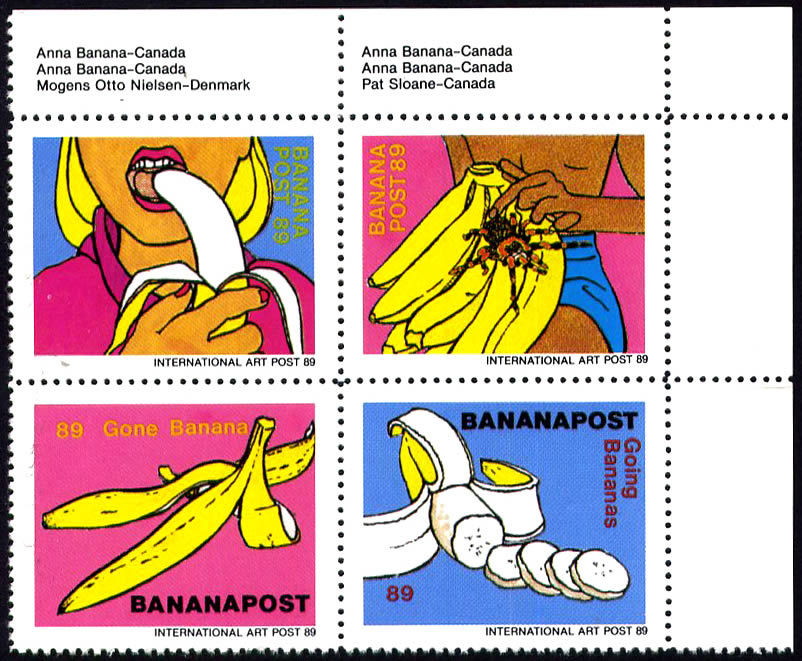
Anna Banana (Canada): an important figure in Mail Art, co-founder of VILE magazine,
She is the first artist to create works in postage stamp format
, the "artistic stamp" ( I will tell you more about these artist stamps in another article. )
Since the early 1970s, she has participated in the mail art movement. known for its envelopes and postcards decorated with collages and stamps.
Lenore Tawney (United States): Mail Art artist. Shortly after beginning her graphic drawings in 1964, she also began exploring collage. She sent hundreds of these as postcards made with scraps of paper, bones, feathers, shells, and other natural materials, annotated with cryptic, sometimes humorous messages, to friends.
Tawney's works act as fragile transmissions.


In discovering the history of Mail Art, I realized that my practice was, unknowingly, part of a long tradition. As a collector of old postcards and mismatched stamps, I reuse them in my collages not simply for aesthetic reasons, but because these papers have already lived—they have traveled, carried words, and stood the test of time. With my collages, I offer them a second journey, transforming this ordinary medium into a true object of artistic correspondence. Reusing, repurposing, sending: without naming it, I was already practicing Mail Art.
Even though mail has become mechanized, travels faster, and is delivered via networks, the magic of the physical medium remains. It's about transforming an ordinary object into a unique piece, imbued with history and ready to circulate beyond the usual channels and through the mail.

Or come to the workshop; you are always welcome.
And find all the articles on collage here


Comments