


Collage: When tearing paper allows you to let go

We live in a world that's constantly moving at breakneck speed. Between flashing notifications and the invisible pressure to always "succeed" at everything we undertake, our minds end up resembling an overloaded browser tab and our brains a hard drive on its last legs. What if the solution to finding a little calm wasn't in a meditation app, but simply at your fingertips?
Artistic collage is much more than simply juxtaposing images on a surface. It's an act of gentle resistance against perfectionism. Unlike drawing or painting, which can sometimes be intimidating due to their technical demands, collage doesn't involve erasing or erasing; it's simply a matter of layering. There are no "bad choices," only intuitions coming together.
We are no longer trying to produce beauty, we are trying to let speak what, within us, has no words.
I want to take you far from technical tutorials to explore the invisible dimension of collage: inner balance, calm, letting go. The simple act of manipulating materials, choosing a color, or tearing a page from an old magazine can become a true ritual for finding your own rhythm, a pause to reconnect with what truly matters. Your scissors might just be your best allies for well-being...
Collage as a sensory anchor: from cold screens to living paper.
Our hands, so often accustomed to gliding on the smooth surface of a screen, rediscover in collage their primary function: that of feeling.
To sit quietly at a table, leaf through magazines and books, and let your instincts guide you as you tear or cut out fragments that inspire you in the moment. To hear the sound of tearing paper, of scissors slicing. To discover with pleasure all the different textures of paper: old books with yellowed pages, the glossy paper of magazines, the fragility of tissue paper, the roughness of cardboard.
Manipulating these textures anchors us in the present moment.
To smell the glue, the old paper, or even the tea that is often forgotten on the edge of the table...
Look for the color or pattern that "vibrates" with our current mood.
The dialogue between your hands and your mind .

The cutting process begins with what already exists. I instinctively select and cut out whatever inspires me in the moment (a color, a face, a word), even if it makes no sense at first. There's no need to reason about the cutting; you let chance guide you. Then there's that magical moment when you lose track of time, focused on assembling the images, torn or cut fragments that should never have met and that, side by side, create a new meaning.
Assembling papers is a bit like recreating order in the chaos of our thoughts. We don't create from nothing; we reorganize the world in our own way.
The aesthetics of imperfection
In our quest to "do it right," we often forget that perfection is the enemy of emotion. Collage, by its very nature, is the art of the magnificent accident.
Like the imperfection highlighted in kintsugi , or the irregularity and visible repair that become elements of beauty in sashiko . This is where the Japanese concept of Wabi-Sabi comes in. - the beauty of things that are imperfect, ephemeral and incomplete - takes on its full meaning.
There is a fundamental difference between an image cut with the surgical precision of a box cutter and an image torn by hand. The beauty of the irregular, sometimes unintentional tear is often more poetic than a perfect snip of the scissors.
• The cutting seeks control.
• The tear , on the other hand, reveals the paper's fiber, its thickness, its fragility.


An irregular edge is not a mistake; it tells the story of your impulse, your hesitation, or your strength at the precise moment your fingers parted the material. By accepting these "jagged" edges, we symbolically accept that not everything in our lives is smooth, and that this is precisely where our poetry lies.
The right to overlap
Collage offers us freedom; the right to change our minds. If you no longer like an arrangement, you can simply cover it up.
“Layering the layers means accepting that our work, just like us, is made of strata, hidden memories, and new opportunities.”
It is this thickness created by successive layers that tells a little bit of the story of your creation. Traces of glue that protrude, papers that warp under humidity or colors that clash, writing that slightly overflows are all signs of life.
By letting go of the final result, we discover that imperfection is not a manufacturing defect, but the path towards what resembles us.
The workshop in your pocket: Create anywhere, anytime
One of the greatest pleasures of collage is its disarming simplicity.
The range is minimal:
• A pair of scissors (the kind that fit well in the hand).
• A tube of glue (the faithful ally that doesn't leak in the bag).
• A few scraps of paper (an old magazine, an envelope received that morning or a museum ticket).
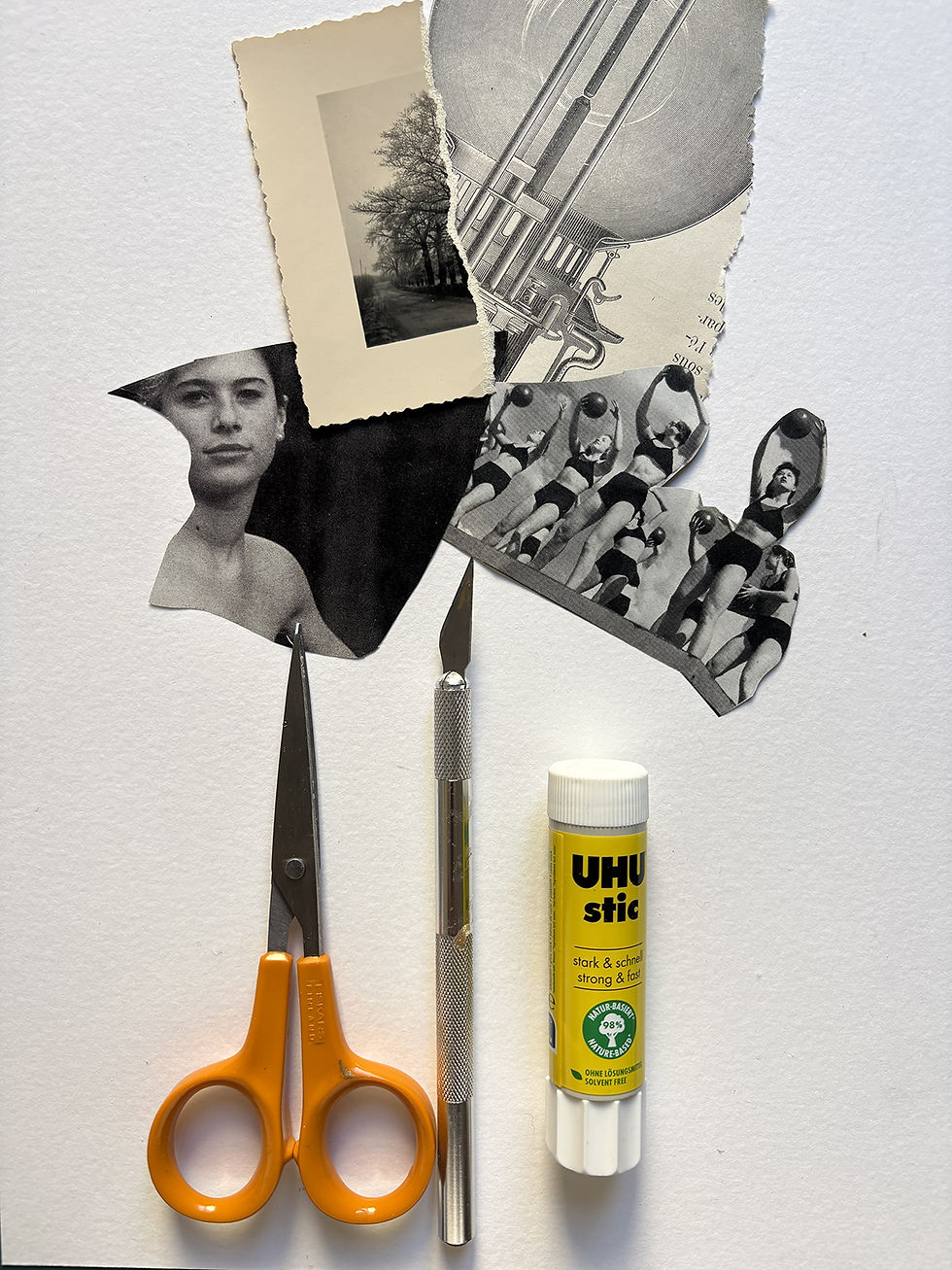

It is this lightness that makes the practice so liberating. You don't create a monumental work, you compose a snapshot. This ease transforms any place into an ephemeral studio. Suddenly, a waiting room or a long journey is no longer a dead time, but an opportunity to gather images, to cut and tear.
"I always carry an envelope with me to store these fragments of paper, and perhaps a small pair of scissors (more complicated). I often start by tearing out pages which I keep in this envelope or folder, and later I cut out a detail, a word, a face…"
Your paper bubble awaits you
Ultimately, artistic collage reminds us of an essential truth: we all need a space where "making" takes precedence over "achieving." By transforming a few fragments of paper into a unique work of art, you are not just creating an image; you are giving yourself a moment of calm in a world that never stops.
It doesn't matter if your creation ends up framed on a wall, tucked into a personal journal, or sent in the mail to brighten a loved one's day. What will remain is that moment when your hands took over from your thoughts.


Comments